
Getting Justice for Candi Joy
Notes from Juror 219

The summons for jury duty came with plenty of notice and I knew to bring a book. The book was Lucky You, by Carl Hiaasen. His books are funny and ideal company for a potential juror in the Keys. The characters are all skeezy nutballs and well-represented in any courtroom down here. If you are somewhat skeezy yourself, Florida’s 16th Circuit is one jurisdiction where you can count on a jury of your peers.
Mark Jones, our 16th Circuit Judge, always does a good job of explaining how things are going to go. I’ve been in his jury pool a couple of times but always excused in the first cohort. This time there were about 80 of us on the benches when the clerk called, “All rise.” Judge Jones told us that a trial was ready to go as soon as they could pick a jury, which he hoped would be that day. The trial would take a week or so and he invited people with special circumstances to speak up so he and his elves could take their circumstances into consideration.
Juror 51 said she was giving a wedding at the Southernmost Mansion on Friday for 55 guests. I had my doubts; the owner had told Betsy and me that he won’t do weddings bigger than ten any more because he can’t abide the mothers, so this one might have been worth a little cross-examination. Juror 158 was a beefy ex-sheriff originally from Louisiana who claimed that defense attorneys didn’t like him because he’s so tough. The chef at Blue Heaven had to break in two new sou-chefs this week, and the head of the Emergency Operations Center at the Naval Air Station was concerned there might be an emergency up there while he was stuck in the jury room. Juror 147 had to go to a funeral because one of his employees had been murdered in Orlando. This was not only a bulletproof excuse, it turned out to be foreshadowing.
Juror 219 didn’t have any special circumstances.
After some behind-the-scenes consideration, 50 names were read out and we were invited to go sit in Courtroom B, which is where the trial would be. Everyone else was excused with thanks. The bailiffs organized us in the gallery in five rows of 10. This was so that the officers of the court could identify us on a grid. The prosecution and defense tables had been turned around so they could get a good look at us during voir dire.
I had two friends in the room. One was Brian Wagstaff. He appeared in one of the “Frog and Duck” stories that I send to my grandchildren as Nice Dr. Wagstaff, and the real Brian is both nice and an MD. Mine, in fact, although I’m not sure that he knows I’ve adopted him. He is married to Tim Peterson who is the Director of Music at St. Paul’s, and we see them around. The other pal was Shelli Skeels. She is a vet, retired about eight minutes ago from a practice in New Jersey that was apparently able to operate without her for long stretches.
There were two holes in the grid, people who had somehow not made it down the hall from courtroom A to courtroom B. A leitmotif in our all-day proceedings was the bailiff's reports on their status. Ultimately, we learned that one person had gone home by mistake and the other had simply disappeared. That left 48 to introduce ourselves to the three prosecutors and what I thought were three defense attorneys. They were looking to pick eight, six jurors and a couple of spares. Then we were informed of the charge. This was a murder trial.
Around the first of August 2017 Billy Earl Baker and Candice “Candi Joy” Cooper got on Interstate 20 in Lindale, Texas, headed for Key West. Thirteen hundred miles later they checked into a hotel and commenced to party. Billy Earl and Candi Joy liked to party. Their people back in Texas said they’d start early in the morning and after a while start in on each other. They’d been fighting more and more lately, and the fights got physical. On August fourth, after drinking and drugging in paradise, they went for a swim off Smathers Beach. The Sun was going down but there was still plenty of light when Billy Earl’s 911 call came in. The Fire Rescue team found Billy Earl watching a good Samaritan give chest compressions to Candi Joy. The Samaritan had taken over – pushed him out of the way, she said – because she didn’t like how he was doing it. He was straddling Candi Joy, for one thing. She wasn’t wearing a top and he was “moving his hands and arms up and down her chest.” She was purple, which was the color of the sky by then, and there was foam dribbling out of her mouth and nose. The autopsy report later determined that Ms. Cooper died as a result of manual strangulation with drowning, and that the manner of death was homicide.
All of this I learned later. In Courtroom B, Judge Jones just read the charge: manual strangulation with drowning. Murder in the second degree was the charge, meaning that Billy Earl hadn’t been thinking it up in the car.
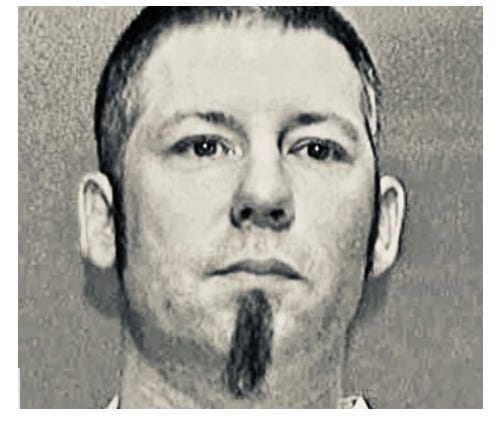
After probing to see if any of us had knowledge of these events, the judge introduced everybody on the other side of the gate from us. When he got to the defense table, the person who I’d thought was the third chair turned out to be the defendant. He was a mild-looking fellow with a Rotary Club haircut. There was a legal pad in front of him and he wore a nice blue blazer over a button-down shirt, open at the collar. He looked upstanding enough to me, maybe because I’ve got the same outfit in my closet. It hasn’t been off the hangers for years, but now I’m planning to keep it. Also, I admired his eyeglasses. They were quietly stylish with thin, tortoise-shell frames – exactly the glasses that I’ve been looking for to make a change. Judge Jones had told us that if we jurors had any questions or requests, we should pass them along through the bailiffs; and I’d been thinking about asking for a lead on these glasses until I learned who was wearing them. My guess is that the defense team prescribed them for Billy Earl, but I’m still interested.
The weight of the charge sank in. The court people had all been introduced to us and now we introduced ourselves back, telling our stories one by one. Only eight would go the distance. First the judge read out the witness list, and asked if any of us had ties with them or other issues that might interfere with things. Then the State and Defense tables asked about our experiences with strangulation or drowning or both, and whether autopsies would bother us. The consensus was that all of these things would bother us. How do we feel about mixing drugs and alcohol? Fine, mostly. My neighbor on the grid told the court “I wake up every morning not knowing who I’m going to be that day!” This was what attorneys call an excited utterance.
In a few hours, the process which at first seemed haphazard had elicited an amazing amount of personal information from tired people who had been sitting on Earth’s hardest benches all day. The lawyers weren’t tired at all. Mr. Mansfield for the State probed our thoughts and feelings about domestic violence while the lawyers made marks on their grids. Mr. Smith for the defense revealed that “there is some disagreement about the facts and what they mean,” and couldn’t resist adding that “The State does not see the reality that we see.” Thus crept in, on little cat feet, a preview of the trial to come, a story of conflicting evidence. Did Candi Joy drown on her own or was she strangled first? How do you even do both? Not only were the facts murky, the circumstantial evidence was, too. Had they been fighting? How would we know? And later: what was Billy Earl doing to her on the beach? We, the jury, were going to have sort all of this out and now both sides wanted to hear our plan for deciding on circumstantial evidence. The woman in front of me answered for all of us. “Well,” she told the Court, “that depends on the circumstances.” It didn’t sound like much of a plan, but none could say her nay because this woman analyzes circumstances for her job. Her name is Maureen Lidek and she’s a national security intelligence officer over at the Joint Interagency Task Force. With all the muddle around circumstances, it’s no wonder that she got picked.
So did Doctors Shelli and Brian, since what actually happened, and in what order, inside Candi Joy was a question. And so did two out of the three people with jury experience. When we told our individual stories, a point of special interest was whether we’d served on a jury that had reached a verdict. Those were the two that got picked; one had even been a foreman. The one who didn’t had served on a hung jury and he’s still mad as hell, said it was the worst experience of his life. Excused. A woman whose husband had served on a hung jury said he suffered from PTSD as a result; so if you ever get on a jury either nail your guy or let him go, else you’ll be tormented forever. Also picked: the ex-Marine pilot, now realtor, and the woman from the county budget office. Been there 25 years, talk about steady. I didn’t like the pilot-turned-realtor. Something was off about him. Warrior flyboy to realtor? I dunno. He’s going to have some issues. Give me the woman who works for the county. The eighth juror was a woman named Mary McDowell and my notes are mute on her account. I like to think that she was the person who disappeared and somehow got empaneled after all.
Juror 219 was excused with thanks.
The trial, as judge Jones predicted, took five days. Yesterday the lawyers made their final presentations and the jury began deliberations. That evening we went to a Christmas concert at St. Paul’s. The Choral Arts Society had not performed live for two years. The hall was full, as you can imagine. Brian and Shelli were among the singers. We ran into her after the performance. The jury had found Billy Earl Baker guilty as charged. It had been a day.